
By Varun Modgill ·
Your ATS Is Hiding Your Best Engineers
India graduates 1.5 million engineers a year, yet 82% of employers struggle to find the right talent. Ironically, only 1 in 6 engineering graduates gets hired, even though most test as job-ready. This is a matching failure, not a talent shortage, and conventional hiring tools are the cause.

The Real Cost of a Wrong Engineering Hire
A wrong engineering hire is incredibly expensive. It wastes weeks of training on someone who doesn't fit, pulls senior engineers away from building to fix basic mistakes, and forces teams to pay a second agency fee when early attrition resets the search.
For hard-to-fill technical roles, that isn't an unlucky exception. It's the predictable output of hiring built on weak signals. The question worth asking is why the tools most teams rely on keep producing those wrong hires.
Why Traditional Tracking Systems Fail
Traditional tracking systems fail because they look for exact text strings. This primitive method rewards rigid job titles over real capability, hiding qualified candidates who simply describe their work differently. Because these systems cannot measure actual skill, they guess engineering capability based on crude proxies like college tiers, trapping talent in strict boxes.
Qualified people get overlooked, and recruiters lose hours re-running searches for roles that should already be closed.
A Different Question: The Skill Tree
Cognavi's patented Skill Tree technology grew out of decades of technical staffing in Japan, a market where matching precise technical requirements is the entire business. While a conventional tracking system asks which resumes contain the right keywords, the Skill Tree asks which engineers can actually do the work. Change the question, and the results change with it.
Structure Against Structure
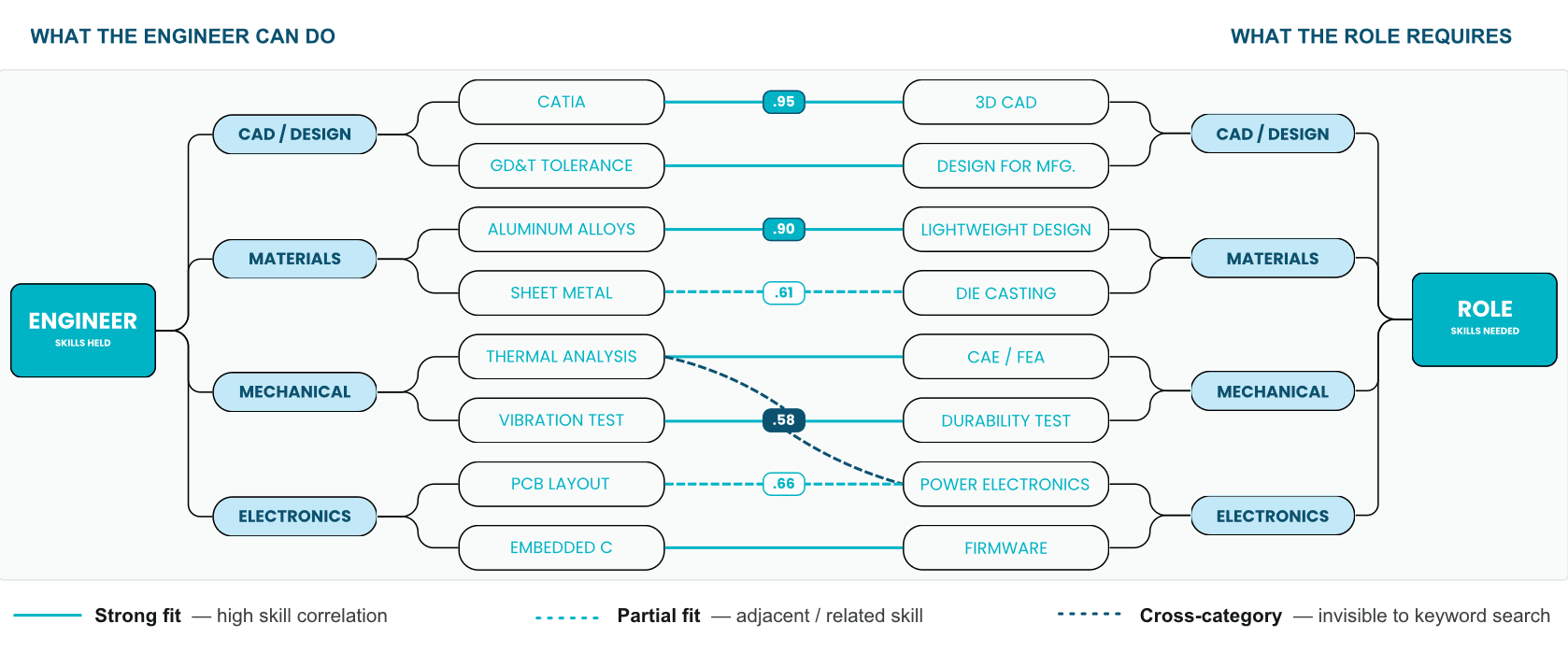
To achieve this, the system compares structure against structure by building two distinct models and measuring the relationship between them. The Candidate Tree maps an engineer's coursework, projects, and proven competencies into a verifiable skills framework that describes them by capability rather than degree title. Simultaneously, the Technical Tree applies the same framework to the role, defining the job by what it genuinely demands rather than by whatever buzzwords landed in the description. The system then aligns the two structures and scores the direct correlation between candidate capability and role requirements. This identifies strong fits with precision and performs a task exact-match search cannot by surfacing adjacent and partial fits.
An Advantage That Compounds
This technical advantage compounds over time. Manual taxonomies freeze the day they are finished and quickly go stale, but the Cognavi engine utilizes a patented skill graph of more than 159,000 terms that expands automatically as technology moves. Run it longer and it grows more precise, widening the gap for any competitor trying to replicate it from a standing start.
Proof in the Market
The model also holds up firmly in the market. Across international engineer placements made through Skill Tree matching, Cognavi recorded an average annual package of ₹42.15 lakh. While that figure reflects international, Japan-bound placements specifically rather than domestic enterprise hiring, it stands as clear evidence that the model successfully finds high-value fits others miss.
Four Commercial Levers
Four commercial levers drive the total return. The engine expands the qualified pool by surfacing adjacent candidates, shortens time-to-fill with instant ranked shortlists, lowers costs by reducing agency reliance, and improves retention by eliminating post-hire mismatches. Together, they convert a recurring technical bottleneck into a repeatable, data-driven pipeline where critical roles are filled faster with professionals who stay.
From Principle to Executable System
While Indian hiring is shifting away from degrees toward demonstrated skills, operationalizing this philosophy at scale is genuinely difficult. The Skill Tree bridges this gap, turning an industry principle into an automated, executable system. If filling specialized engineering roles has become a bottleneck for your team, the next step is to test the model against your hardest open requirements.
You can book a demo with the Cognavi team today at https://www.cognavi.com/book-a-demo
Where this goes next
Graduate hiring for enterprisesSee how Skill Tree matching delivers a shortlist of verified engineering graduates instead of a keyword-filtered pile of resumes.
Written by
Varun ModgillManaging Director, Cognavi India
Varun Modgill is Managing Director of Cognavi India, where he leads the skills-first hiring platform connecting engineering graduates, universities and enterprises across India and Japan. He writes on campus hiring, skills-based assessment and the graduate talent market.