
By Varun Modgill ·
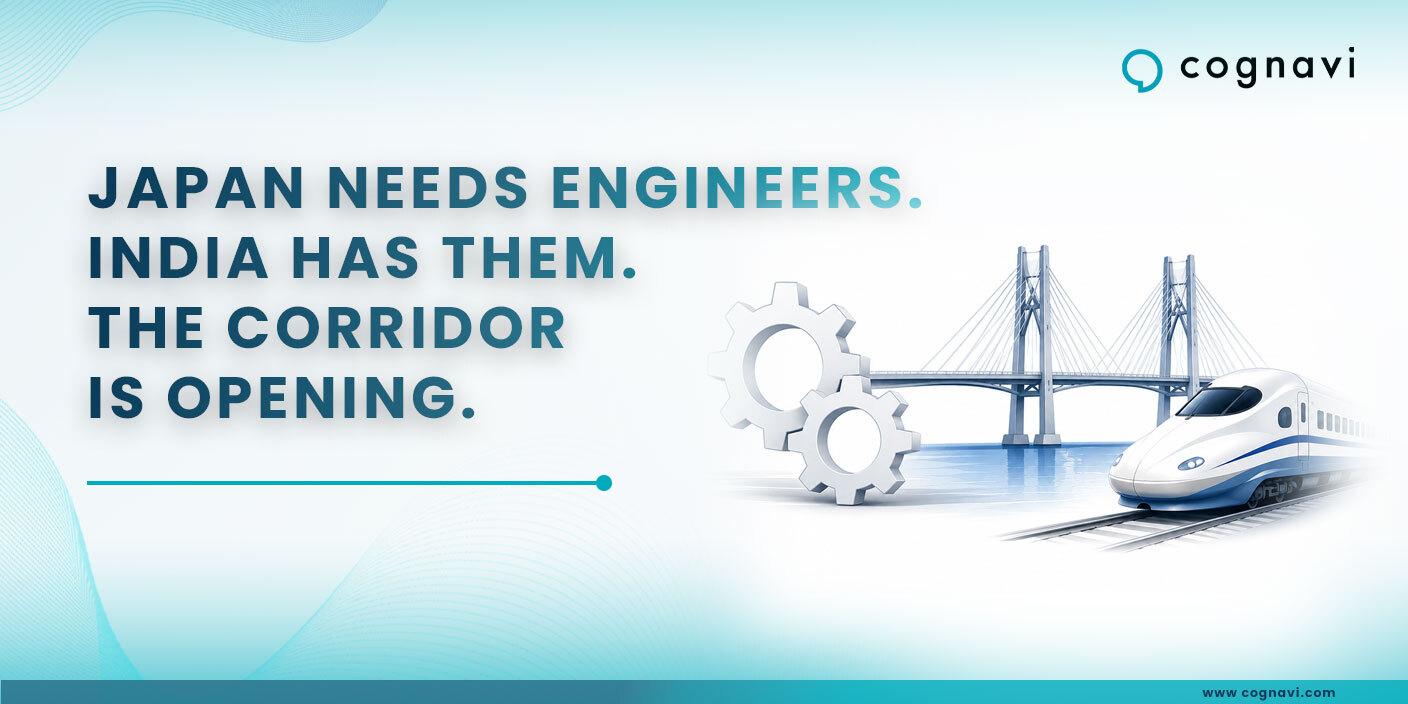
Japan Needs Engineers. India Has Them. The Corridor Is Opening.
One country has the roles and not the people. The other has the people and not enough roles. Connecting the two isn't just a clever idea; it is an absolute economic necessity.
The Shortage Is Structural, Not Cyclical
Japan is running short of workers, and the macroeconomic data is stark. The share of its population aged 65 or older reached 29% in 2023, by far the highest of any country in the world, and it is still climbing. The Bank of Japan's Tankan survey put its employment diffusion index at minus 35 across all industries, one of the lowest readings in three decades and a clear signal of widespread labour shortage.
The strain falls hardest on the sectors Japan built its economy on: manufacturing and core engineering, where global giants like Toyota, Honda, Hitachi and the dense network of suppliers beneath them need engineers faster than the country can produce them.
India Sits on the Other Side of the Equation
India graduates more than a million engineers a year, more technical talent than its own market can absorb. The evidence shows the correction is already under way:
- Foreign workers make up only about 3% of Japan's labour force.
- Yet they accounted for more than half of its labour-force growth between 2023 and 2024.
The corridor is opening, and the traffic is beginning to move.
What the Work in Japan Program Connects
Cognavi runs that connection as the Work in Japan Program, a structured talent corridor rather than a one-off recruitment drive. The demand it serves is concentrated where India's engineering ecosystem is strongest: manufacturing, mechanical and electrical engineering, automotive R&D and production, robotics and industrial automation, alongside IT, cloud, AI and semiconductor design.
The scale is the point. Through Forum Engineering, Cognavi's parent company, the program connects directly to over 1,400 client companies across Japan, most of them in manufacturing and core engineering, a deeply rooted enterprise network no job board or campus drive can match.
The Corridor Is Not Frictionless
The honest version of the story matters more than the brochure. Language remains the ultimate gate. Pure-engineering and multinational roles increasingly run in English, but most traditional Japanese employers still expect professional-level Japanese for long-term career growth, and immigration rules now require proof of Japanese ability for certain customer-facing roles.
Japan's Engineer visa also mandates strict salary parity with Japanese nationals. That protects the candidate from wage exploitation, but it means employers screen candidates with immense scrutiny before making an offer. The engineers who succeed treat language and cultural preparation as part of the core job, not an afterthought.
A Matching Problem, Not a Placement Problem
That is the part the market underestimates. The employer needs to know a candidate can handle the technical workload on day one, because salary-parity rules and international relocation costs make a wrong hire expensive. The candidate needs a role that aligns with their actual capabilities rather than a generic resume keyword, in a country where a professional mismatch is far harder to walk away from than a job across town.
Verifying what an engineer can actually do, and matching it precisely to what a Japanese enterprise demands, is the difference between a corridor that thrives and one that produces expensive failures on both ends.
Four Decades of Matching, Brought to Indian Graduates
This is the ground Cognavi was built on. Forum Engineering has spent more than four decades matching engineers to technical roles in Japan, the one market where precise technical matching is the entire business. The Work in Japan Program brings that heritage to Indian graduates:
- A skills-first assessment that shows an employer what a candidate can execute rather than just where they studied.
- A 1,400-company network to match them into.
- End-to-end language training and visa support that turns a theoretical offer into a physical arrival.
For students and universities, it is a direct route to a global engineering career. For Japanese companies, it is dependable access to the engineering talent their shortage demands.
The Corridor Is Open. The Work Is Matching.
The corridor between India's engineering surplus and Japan's engineering shortage is open. The work now is making sure the right people move through it, matched to the right roles, based on evidence rather than guesswork.
For engineers weighing a career in Japan, and for employers looking to hire them, that is the bridge the Work in Japan Program exists to build. Book a demo with the Cognavi team at https://www.cognavi.com/book-a-demo
Where this goes next
Engineering jobs in JapanSee how Indian engineers move into roles in Japan through Forum Engineering's network of partner companies.
Written by
Varun ModgillManaging Director, Cognavi India
Varun Modgill is Managing Director of Cognavi India, where he leads the skills-first hiring platform connecting engineering graduates, universities and enterprises across India and Japan. He writes on campus hiring, skills-based assessment and the graduate talent market.