
By Varun Modgill ·
Where the Paper Trail Ends and Proof Begins
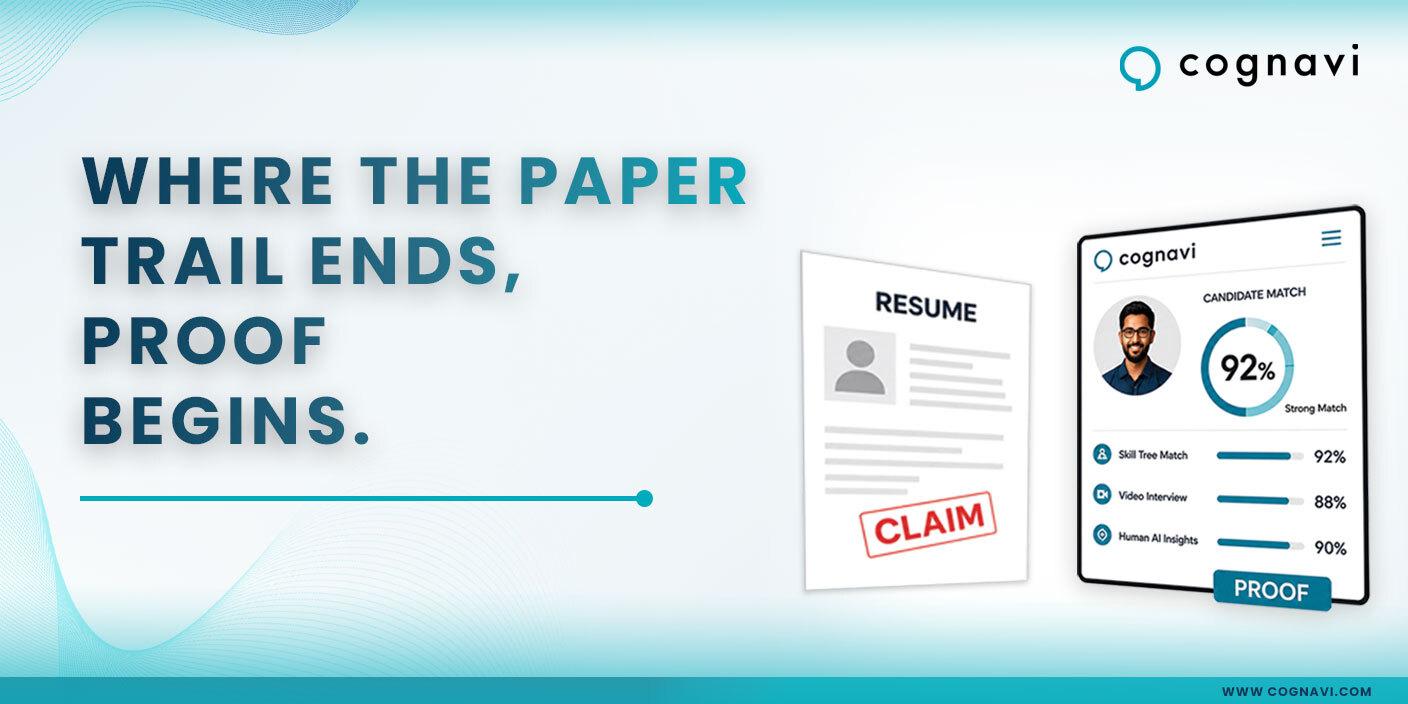
A resume is a claim, not evidence. It lists where candidates sat and what they say they did, forcing recruiters to infer true capability from a page of self-reported text.
The Document Outlives the Signal
For decades, talent acquisition teams had no better option. Today, however, relying on resumes forces companies to filter by crude proxies such as job titles, keywords, and pedigree instead of actual ability. Consider this: the most relied-upon proxy, a four-year degree, has a correlation with job performance that sits barely above zero.
The current system optimizes for the document instead of the person. It rewards polished resume writers while masking the hidden talent capable of doing the work.
Every Hiring Failure Is a Failure of Prediction
The economic burden of this matching failure is staggering. Once you calculate prolonged onboarding friction, sluggish time-to-productivity, and the inevitable cost of re-hiring, a bad hire costs anywhere from 30% to 200% of their annual salary. Unsurprisingly, mis-hires remain the top concern for talent acquisition leaders.
Every hiring failure represents a breakdown where a resume promised a capability that the hire simply could not deliver. To eliminate this financial drain, organizations must accelerate the candidate break-even velocity by replacing weak resume signals with evidence-based evaluation.
What the Data Says About Skills-Based Evaluation
Skills-based evaluation completely inverts the traditional model. Instead of asking what candidates claim, it measures what they can demonstrate.
- 76% of employers report that hiring for skills yields superior outcomes compared to relying on education alone.
- 89% of employers utilizing skills-based methods saw employee retention skyrocket.
The driver behind this data is genuine fit. When you bypass resume claims and select for verified capability, your new hire time-to-productivity compresses. Professionals hired for proven ability have far less reason to disengage than individuals hired for an outdated credential loosely related to the daily job.
Good Intentions Are Not Infrastructure
Yet, operationalizing this shift at scale is genuinely difficult. Simply dropping the degree requirement from a job description changes almost nothing on its own.
Research from Harvard and the Burning Glass Institute revealed a stark truth: even after several large firms lifted degree requirements, fewer than 1 in 700 hires were non-degree candidates. This happens because legacy, resume-first habits are deeply ingrained in corporate workflows. Skills-based hiring cannot work on good intentions alone. It only succeeds when organizations intentionally rebuild their screening infrastructure around objective evidence, which requires a platform built specifically for the job.
The Skill Tree: Capability Against Requirement
Cognavi replaces legacy habits with a modern platform that qualifies candidates using objective data from application to offer. The Skill Tree serves as the backbone of this system. It instantly maps a candidate's actual abilities against your specific job requirements. By generating a clear correlation score, it tells recruiters exactly how well a candidate fits the role without any guesswork.
Measuring What a Flat Document Cannot Capture
The platform also measures the vital human qualities that a flat text document cannot capture.
Video Interview evaluates standardized video answers for clarity and communication, providing an objective score along with clear, transparent reasoning.
Human AIuses validated personality and aptitude assessments to match a candidate's natural working style with the job.
This shifts culture fit from a subjective interview guess to an accurate, data-backed profile. Together, these tools give you a complete picture of what candidates can achieve, how they express themselves, and how they work with a team.
Build a Process That Can Tell Them Apart
The right people for your critical roles rarely have the most polished resumes. They are simply the ones who can do the job well. It is time to build a hiring process that can tell them apart and get them up to speed quickly from day one.
Test a skills-first approach against your hardest open roles. Book a demo with the Cognavi team at https://www.cognavi.com/book-a-demo
Where this goes next
Graduate hiring for enterprisesSee how Skill Tree matching delivers a shortlist of verified engineering graduates instead of a keyword-filtered pile of resumes.
Written by
Varun ModgillManaging Director, Cognavi India
Varun Modgill is Managing Director of Cognavi India, where he leads the skills-first hiring platform connecting engineering graduates, universities and enterprises across India and Japan. He writes on campus hiring, skills-based assessment and the graduate talent market.