
By Varun Modgill ·
What Four Years on Campus Actually Buys You
Most engineering students learn to code early. Few realize which half of their skill set is actually scarce.
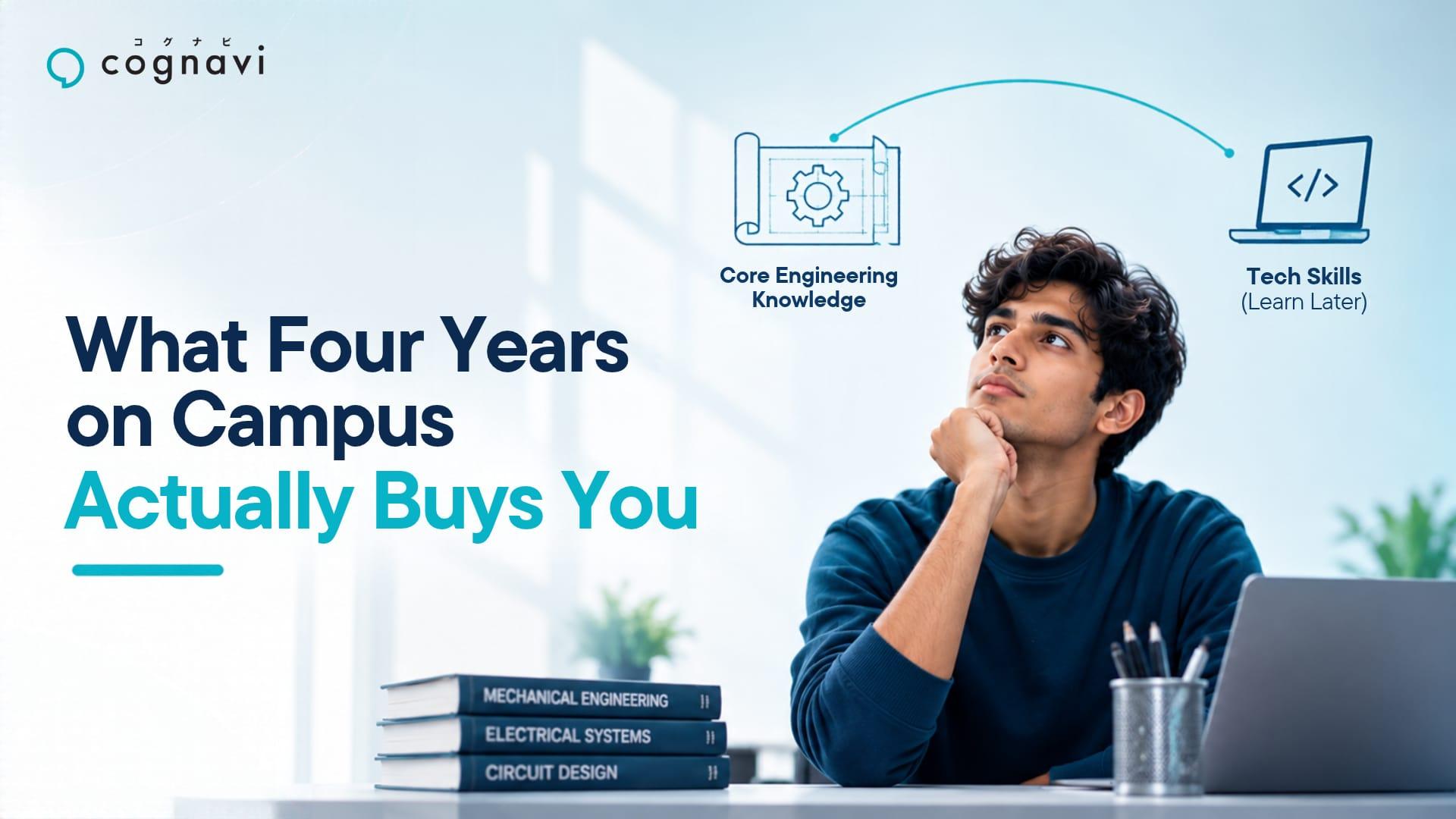
You can pick up Python in a few focused months. Thousands of mechanical and electrical students do it every year. Now try the reverse: try mastering control theory, thermodynamics, or machine design alone, without a lab. Core engineering knowledge takes years, specialized equipment, structured teaching, and live feedback.
One half of a hybrid engineering profile is easy to pick up anytime. The other is slow, expensive, and almost exclusively available on campus. That asymmetry is the most valuable thing to understand about your degree. It is also exactly what the job market is looking for.
The World Economic Forum’s Future of Jobs Report 2025 highlights that employers are not seeking less specialization in hands-on fields, instead they want higher specialization that combines practical engineering with technological literacy. Growth isn't happening in pure software or pure hardware; it is happening in the overlap.
Your core branch isn't holding you back. It is the harder half of the profile employers lack. Here is how to finish building it:
- Master one core domain: Pick depth over breadth—power electronics, thermal systems, PLCs, or embedded design.
- Apply tech intentionally: Learn domain-specific software (e.g., MATLAB for mechanical, Embedded C for electrical) and build one working project rather than collecting six generic certificates.
- Make the capability legible: Standard resumes fail to showcase hybrid skills.
This visibility gap is why Cognavi exists. Our patented Skill Tree maps your coursework, hands-on projects, and technical competencies into a clear profile, matching you directly with core engineering employers like Omron, Komatsu, Toshiba, and Godrej.
Campus gives you the hardware foundation that software can't replace. Build the hard half while you are there, the software layer will wait for you.
Where this goes next
Build your skills profileSee how students build a verified skills profile and get matched to roles on capability rather than pedigree.
Written by
Varun ModgillManaging Director, Cognavi India
Varun Modgill is Managing Director of Cognavi India, where he leads the skills-first hiring platform connecting engineering graduates, universities and enterprises across India and Japan. He writes on campus hiring, skills-based assessment and the graduate talent market.